Choose SessionHUD as the camera in your video-call app. Put
the live take, record status and elapsed time beside your room camera, so a missed announcement
doesn’t mean a lost take number. Your clients install nothing.
Your room camera with a take card placed beside you. Staged, generated photo; the custom
Booth Amber layout is rendered by SessionHUD.
One picture for the call. Your room camera and session information leave
SessionHUD as a single video frame. Check your video app’s camera selection and effects
before the session. See setup and video-app settings.
The text stays sharp. SessionHUD draws the take into the frame itself.
Mirror the room in SessionHUD and the take stays readable. Turn off your video app’s
own effects; some apps mirror your self-view even though clients see the text correctly.
Your own camera layouts. Two built-in camera layouts are ready to use in
the evaluation. A paid license lets you
edit them or build your own with up to eight cards and HUD elements, plus your camera and logo.
Custom layouts and branding require a paid license.
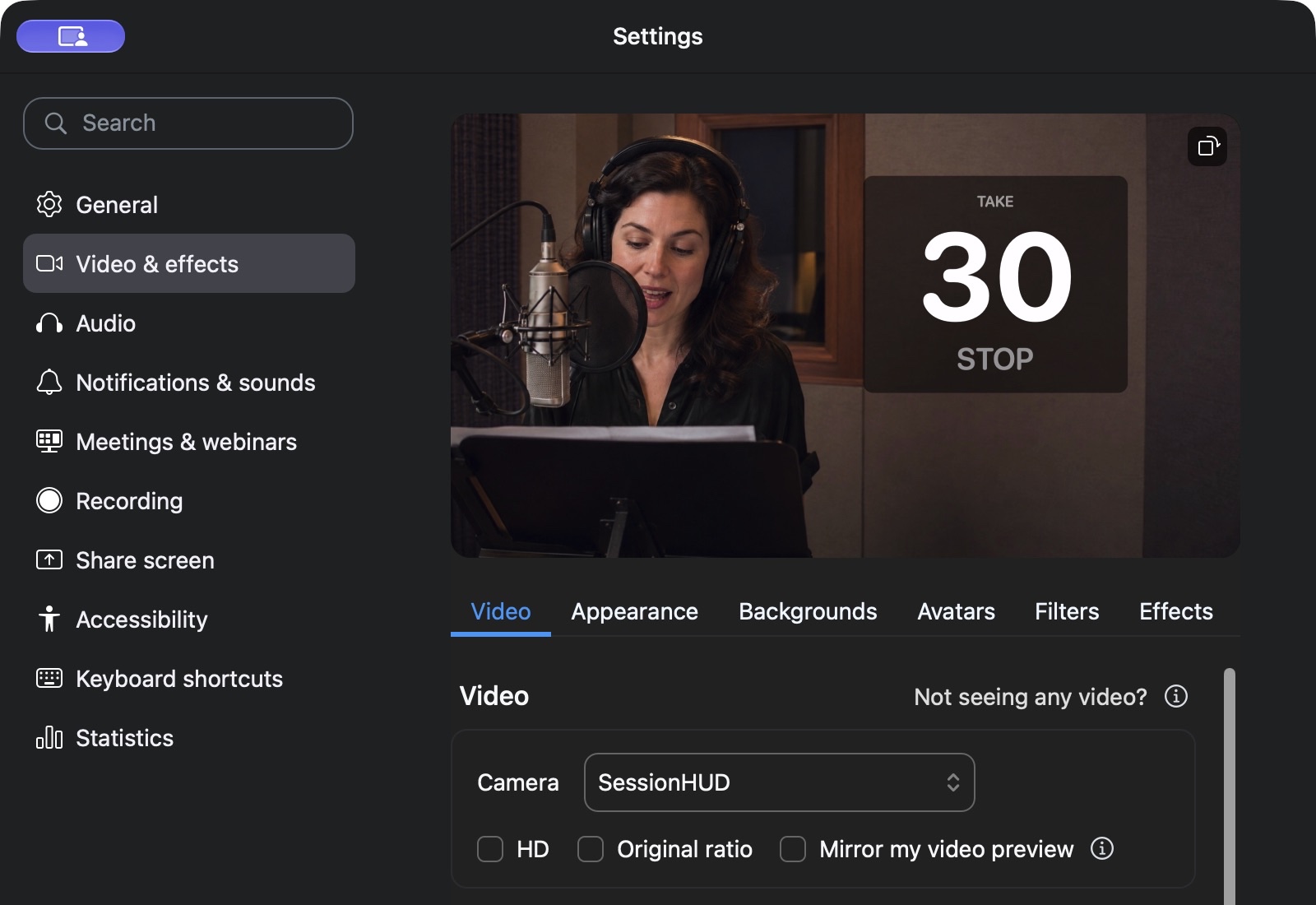
Your take, right in Zoom.
Select SessionHUD as your camera. Your layout arrives as one video
frame, with the take already in the picture.
Actual Zoom settings preview, captured from the running app. The demo uses a
staged, generated booth photo and a custom camera layout, which requires a paid license.
View larger screenshot.
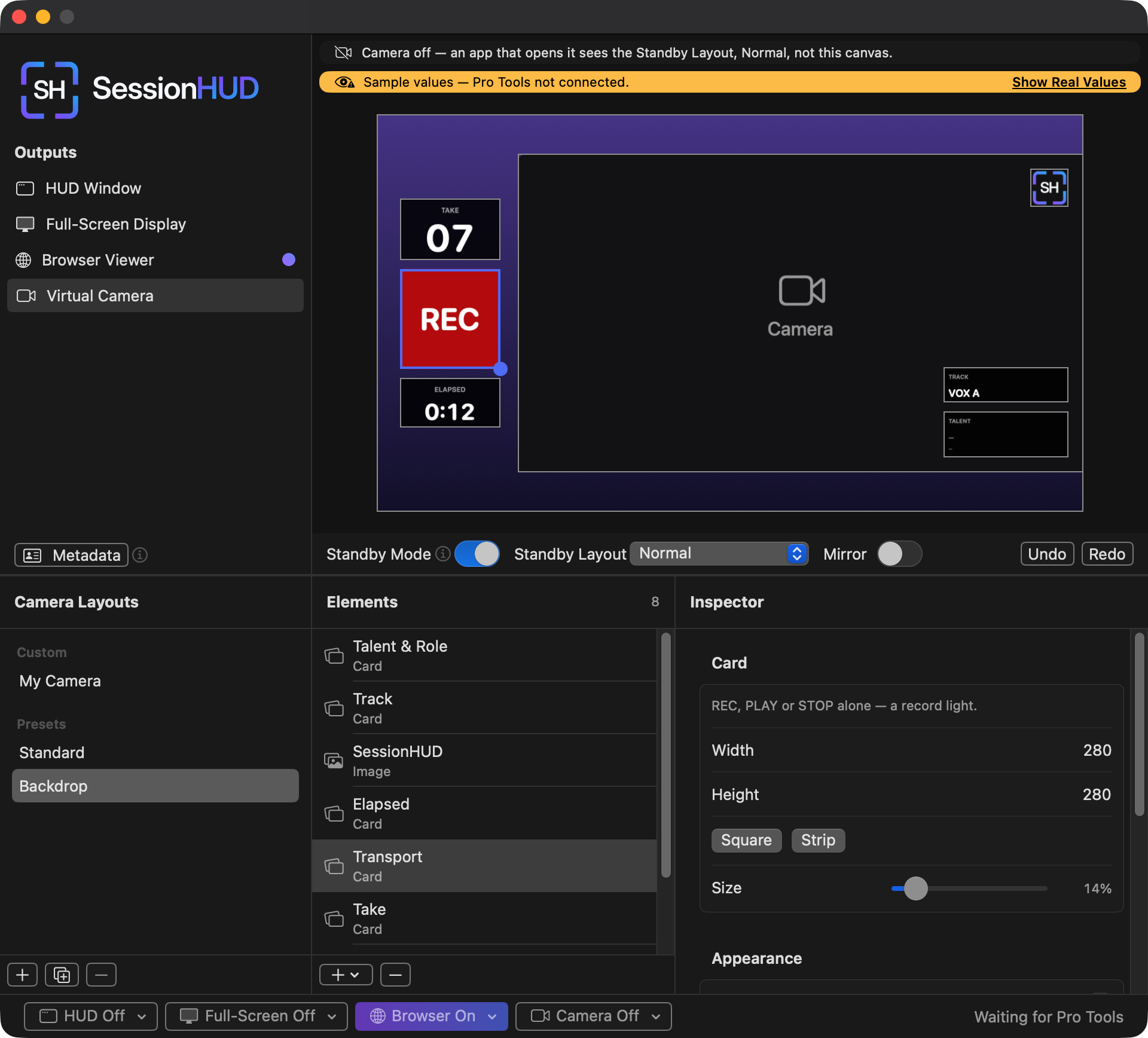
See camera layouts, branding and standby optionsThe Backdrop layout: your camera in a box, with cards beside it and laid over it.
The REC card turns red while you record and green while you play back. Staged, generated photo; the
cards and the box are a real SessionHUD render.
Your studio’s look Your logo, a background image, color or
gradient of your own, and labels in your words, like CUE in place of TRACK for ADR.
Requires a paid license.
Standby, not a frozen frame Turn the camera off and the call keeps the
take on screen under a caption you choose, such as STANDBY or BACK IN
5.
Or your layout, camera off With Standby off, the call keeps your
camera layout with a Camera off card where the room was, or the card alone if
you’d rather. If SessionHUD isn’t running, the card says that instead.
Try the camera in your next session
14 days with all four outputs and built-in presets. No sign-up. Custom layouts and
branding require a paid license.
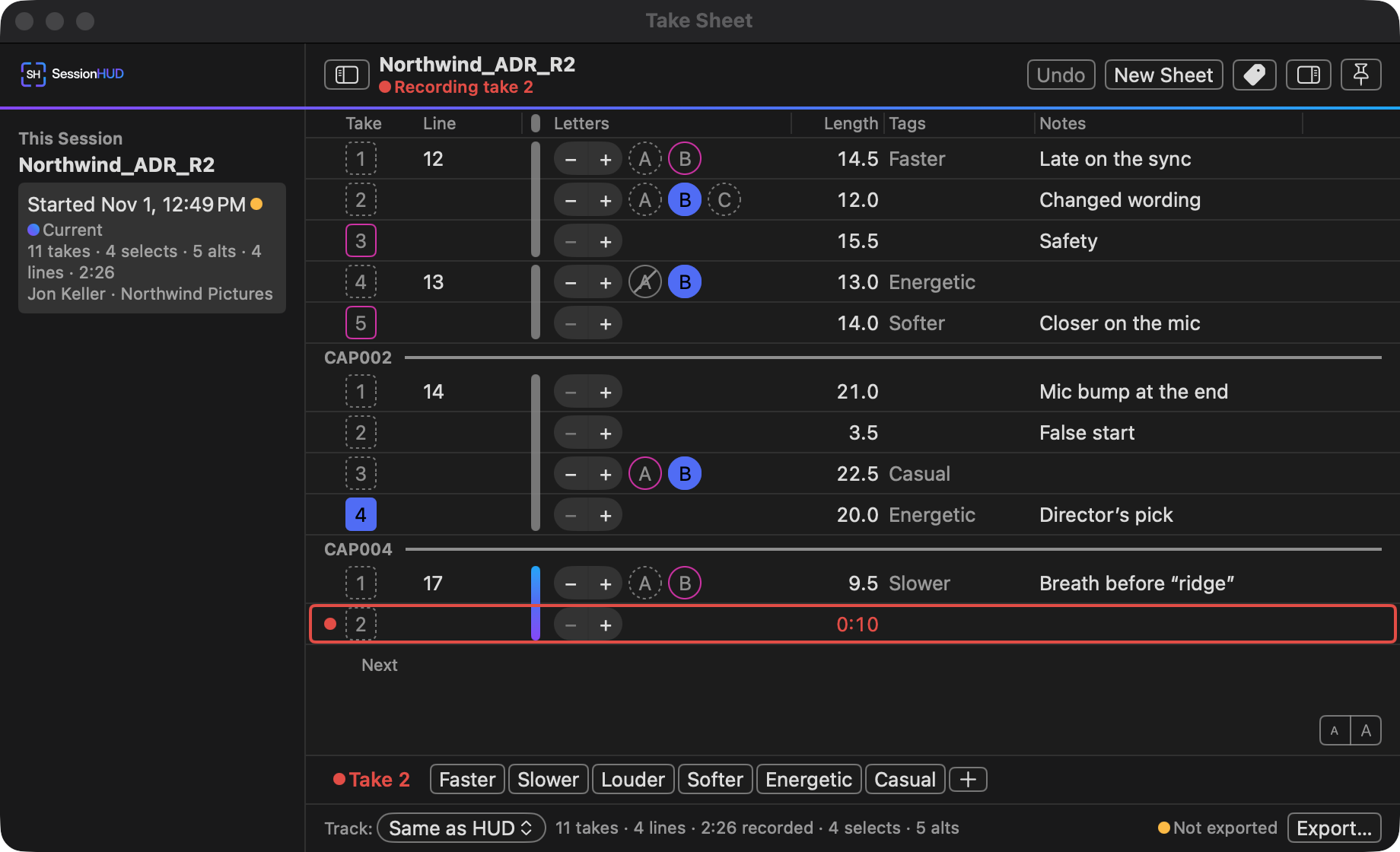
Every record pass becomes a row as it starts. Mark the selects and
alts, tag each take, type the script line, and when the session ends send the client a PDF
and the editor a spreadsheet.
Take Sheet. The actual window during a take.
Logged as you record. Each pass is a row: the take number, when it
started, its timecode, how long it ran and the file Pro Tools wrote. The take being
recorded is ringed in red and its length counts up; when you stop, the file’s own
length replaces the count. Several armed tracks are still one row, numbered by the
same track as your outputs.
Mark selects and alts without leaving Pro Tools. Click a take number for
a select, right-click it for an alt. When a line is read more than once in a take, press
+ for a letter per read — A, B, C — and mark the letters instead.
When every take is three lines in a row, each new take can start with A, B and C. Clicks on
take numbers and letters leave Pro Tools in front, so the space bar still runs the
transport.
Tags for what you’d say about a take. Faster, Slower, Softer,
Energetic: click the word onto the take as you hear it, even mid-take, and Pro Tools keeps
the keyboard. Add your own words to the list. They print in their own column or at the
start of the notes.
Lines, cues and groups. Type the script line on the take that starts
it, such as 35, 46-51 or 46A-54AD, and every take after it is under that line until you
type the next, joined by a bar. Cue numbers carry forward too. A column of your own,
such as Spot or Episode, can group the lines inside it, up to three levels.
Your columns. Show, hide, rename, move and resize any column but the
take number, and add your own: Character, Mic, Scene. Columns, grouping and look are kept
as a setup, so an ADR session and a music session can each keep theirs.
Knows what went out. Each sheet says whether it has been exported since
it last changed, and closing a session whose sheet hasn’t gone out says so. Come back
to a session on another day and it offers a fresh sheet for the day’s takes.
Keeps up with Pro Tools. Undo a take and record again, and the sheet
hides the undone take and gives the new one its own row; Keep moves anything you
typed across. A take that has left the session, or whose file can’t be found, is struck
through and left out of exports, and a number Pro Tools skipped is marked Burned, so the gap
is explained.
New Take from the sheet. One press stops the take and starts the next,
with the line you typed already on it, and Pro Tools keeps the keyboard. It works in
QuickPunch and Normal and is dim during playback, and it sends nothing until you press it.
Settings hides it if you’d rather not have it.
Selects and alts. A select is filled and an alt outlined, so
they still read apart on a black-and-white printout.
Which read did we pick?
Mark a read on the take sheet and its letter lights up on the Take Log. A filled letter
marks a select, a solid ring marks an alt, and a border follows the take being recorded.
Choose Take Log in the Designer for four recent takes on the HUD Window
or the producer’s browser, or ten on the booth display. For a video call, add the
five-row Take Log card to the camera layout.
Take 1048 is recording. The booth can still see the calls on the previous nine takes.
For the client and the editor
Export as PDF, CSV or Excel
Preview the file before you save it.
Choose every take, selects only, or selects and alts, and which columns go out. The
PDF’s header carries the details you type, such as client and talent, and the date
the takes were recorded, and you choose its paper, text size and spacing. The save panel
opens in the session’s Bounced Files folder, and nothing is written until you press
Save. Your studio’s name and logo on the PDF require a paid
license.
Add takes from session files
For takes recorded before SessionHUD was
open, it reads the session’s record folders, never writing to them, and lists every
take with a tick: add the ones a sheet missed, or make one sheet of the whole
session.
Never invented
Take numbers, files and timing are what was recorded and
can’t be edited; a correction goes in Notes. A value nobody measured is a dash, and
a take canceled in Pro Tools leaves the sheet. Rows built from files are kept as read from
the files, not watched being recorded, and Diagnostics says so.
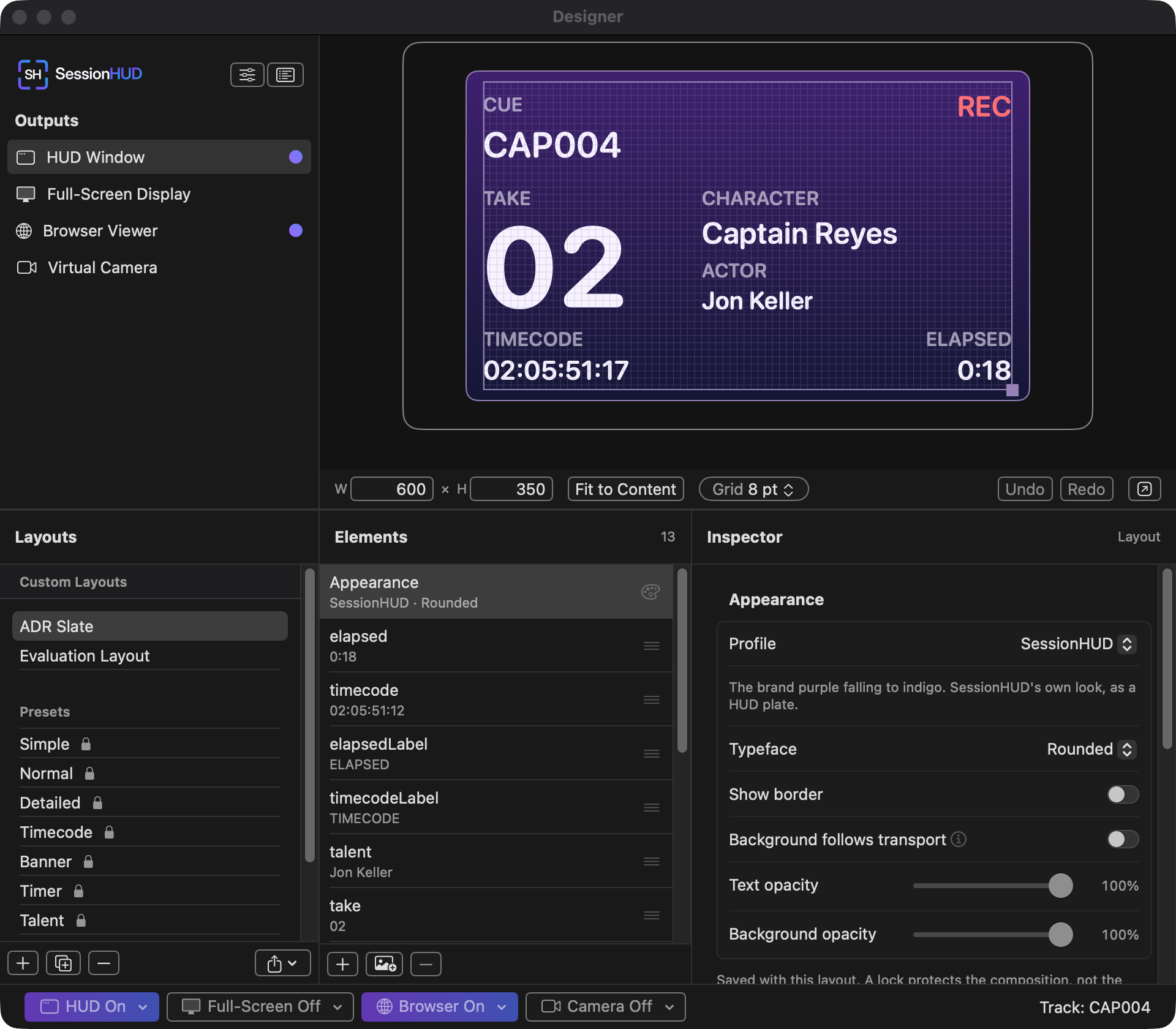
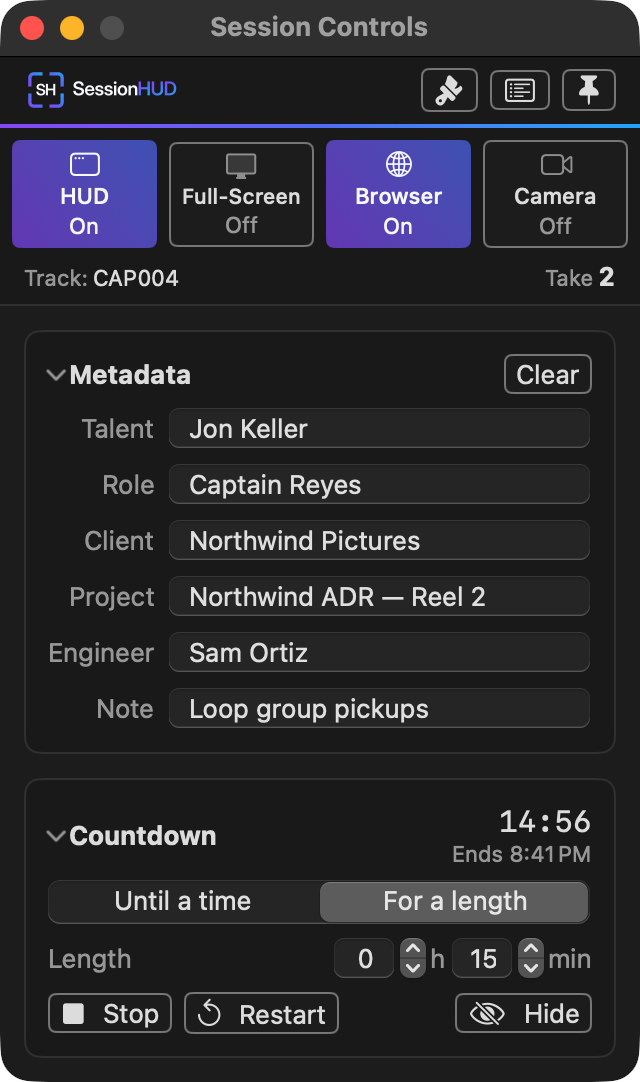
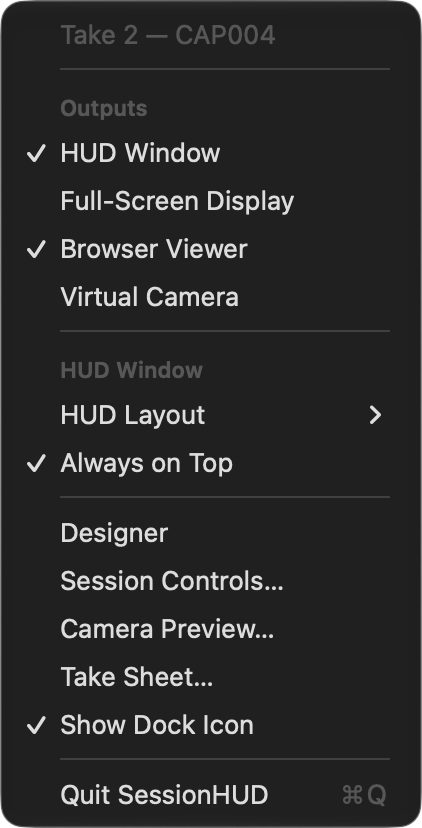
Lay out every output in the Designer. Keep the everyday controls
close in Session Controls or the macOS menu bar, and the session’s takes in the Take
Sheet.
The full designer and branding require a paid license.
The 14-day evaluation includes all four outputs and built-in presets, an Evaluation Layout on
each output to try the designer with — blank, or copied from any preset — plus preset
Appearance settings.
Session Controls
Enter names and notes, run a countdown, switch outputs, open Camera Preview and start the
next take, from one small window.
The manual covers setup and each window’s controls.
Layouts and looks
Layouts for each output.
Choose from eleven preset families. Put a single take number beside
Pro Tools, a timecode clock across the booth monitor or the last four takes on the
producer’s tablet. Each layout has its own color profile and typeface.
Detailed pairs the live take and track with the previous three takes and
their marks. Talent keeps the take prominent, with the performer and role below.
For your own screen, choose Producer to see elapsed time and, while a countdown
is visible, a small footer with time remaining and wrap time. Choose Talent separately on the booth display.
The Normal layout at take 07, in six of the ten color profiles. Profiles
are checked for contrast across transport states to keep the take readable.
Design your own. Add fields to a canvas and drag them into place: take,
track, file, transport and record mode, elapsed and timecode, session format, and the talent,
role, client, project, engineer and note you type in. Elements snap to each other’s
edges and centers and never overlap; ⇧-click to move several together. Requires a paid license.
Your studio’s brand. Add your logo to a layout. It travels
inside the layout file when you export it to another room. Requires a paid license.
Show it only when it matters. Any field can appear only while
recording, only while stopped, or only once there is something to show. Requires a paid license.
A floating text-and-image layout with its own size and opacity.
HUD controls.
Full-screen display
Its own layouts and display placement. The built-in Banner
preset is not offered here; Place the Block positions a layout on the display.
Display controls.
Browser viewer
Its own layout, shared by viewers on the same local network.
Browser rendering and available fonts can differ from the Mac outputs.
Browser setup.
Virtual camera
A separate camera composition with cards, HUD layouts, images and
a camera source. Cards and HUDs together are limited to eight.
Camera designer.
A saved layout belongs to its output type. The API supplies data;
an integration must render its own visuals. Remote clients see the virtual-camera frame
through the video-call service, while the browser viewer stays on your studio network.
Booth display
A screen talent can read from the microphone
Put the session on any display connected to your Mac, such as a monitor
in the booth or on the client couch, with layouts made to be read across a room.
The right screen, every time. SessionHUD remembers the monitor through
sleep, a cable pull and a reboot. If it is missing, nothing is shown rather than the take
landing on the wrong screen.
Never in your way. Clicks pass straight through it, it steps behind
SessionHUD’s own windows whenever you switch to SessionHUD, and SessionHUD’s
menu bar or Dock icon turns it off from anywhere.
Only while recording, if you like. The display can stay dark until the
transport goes into record.
Background follows transport. Red while recording, green while
playing, on any output, so the booth knows it’s rolling without reading a word. The
shades are picked so the text stays readable on both.
The whole team can follow the session in a web browser on an iPad,
laptop or phone on the same local network as your Mac, with nothing to install.
Turn on Background follows transport to make it a record lamp as well as a take display.
For a remote client, use the virtual camera in your video call.
The whole screen turns red while Pro Tools records and
green on playback, with the take on it. Prop one outside the booth door, on the
talent’s stand or on the producer’s desk, and everyone knows when you’re
rolling without asking.
One layout, every screen. Pick a browser layout, from a single big
take number to the current take beside the previous three calls, and every open page shows
the same take at the same moment.
Stream Deck, Companion and OBS. A built-in feed lets a Companion button
show the take and turn red while you record.
The API reference, with recipes for Companion,
OBS and a tally light.
HUD window
On your desk, over Pro Tools
A floating panel you place anywhere, at the size and opacity you
choose, that stays in front of Pro Tools while you work.
Click-through. Leave it over the edit window and click straight
through it.
Share just the panel in a call. Zoom, Meet and Teams leave
always-on-top windows out of their share pickers. Turn off Always on top
and the panel stops floating, so you can share it on its own.
Room for long names. It can widen to fit a long track name rather than
cutting it off.
The take number
The number Pro Tools doesn’t show you
Pro Tools doesn’t tell other apps which take is recording.
SessionHUD works it out from the files Pro Tools writes and puts the same number on every
screen as soon as recording starts.
Recording Take 08, timed from its first second.
Stopped The take stays on screen while you play it back.
Canceled⌘. discards take 08; the panel reads DEL and goes
back to 07.
A dash, never a made-up number. If SessionHUD can’t tell which
take is recording, every screen shows a dash until it can.
Play doesn’t advance it. QuickPunch and TrackPunch create the next
file the moment you press Play. SessionHUD waits until Pro Tools is really recording, and a
punch in and out on one roll keeps one number.
Picks up where you left off. Arm a track and every screen shows the
last take already in its folder, so a cue with 22 takes doesn’t start the day at
take 1.
Elapsed time, per take. Every take is timed from zero, so everyone can
see how long this one has been rolling, not just where it sits in the session.
Loop record and several armed tracks. A loop pass is one take. With more
than one track armed, each keeps its own numbering and you choose which one the screens
follow.
Timecode, too. Point Pro Tools’ MTC generator at the
SessionHUD MTC port and any layout can show timecode and frame rate.
Every output, the camera included, is free for 14 days with the built-in
layouts. Designing your own layouts and adding your branding are not available during the
evaluation.